Together towards a circular future. An interdisciplinary team, a shared vision: the Circular Lab project, funded by the European Union, the Swiss Confederation and Interreg, brings together research, industry and innovation with Re:Circled to radically rethink manufacturing processes in the furniture industry in a circular way, close loops and create new added value from offcuts.
A circular project closes the textile loop.
Together with the Albstadt-Sigmaringen University, the German furniture manufacturer Interstuhl, the Swiss innovation company RethinkResource and HSG Master's student Jan Winiger, CLIMATEX is presenting Re:Circled: a forward-looking showcase demonstrating new paths for a sustainable circular economy in the textile industry. The focus is on the vision of no longer viewing textile production waste, or 'offcuts', as waste, but rather as a valuable resource for new materials. In collaboration with key partners, CLIMATEX is developing a circular model to provide tangible momentum for the transformation of a linear industry into a circular one. As part of the Circular Lab, an interdisciplinary innovation hub in the Lake Constance region, the project is supported by the four-country region's scientific network with funding from Interreg, the European Union and the Swiss Confederation. The Circular Lab promotes circular innovations in textiles, agriculture and food.
“At Albstadt-Sigmaringen University, we are delighted to be working on projects such as Re:Circled as part of the Circular Lab. These projects demonstrate a contribution to the circular economy from a conceptual perspective and aim to implement this concept in specific business are.”
Interdisciplinary innovation forge for circularity.
With six universities and over 30 companies from three countries, the innovative Circular Lab hub promotes the circular economy with concentrated expertise. Following a two-year application process, The innovative Circular Lab hub, which brings together six universities and over 30 companies from three countries, promotes the circular economy by consolidating expertise in this area. Following a two-year application process, the University of St. Gallen (HSG) launched the Circular Lab in June 2023, initiating cross-industry circular projects. As well as universities, companies from the textile, agriculture and food industries are involved too. All key points of the EU's Circular Economy Action Plan and the European Green Deal are covered. Franziska Ostermeier, Global Sales Manager at CLIMATEX and project manager, is delighted with the jointly developed goals: «With this pioneering project, we are not only closing the circle — we are showing the industry how to turn supposed waste into new raw materials.»
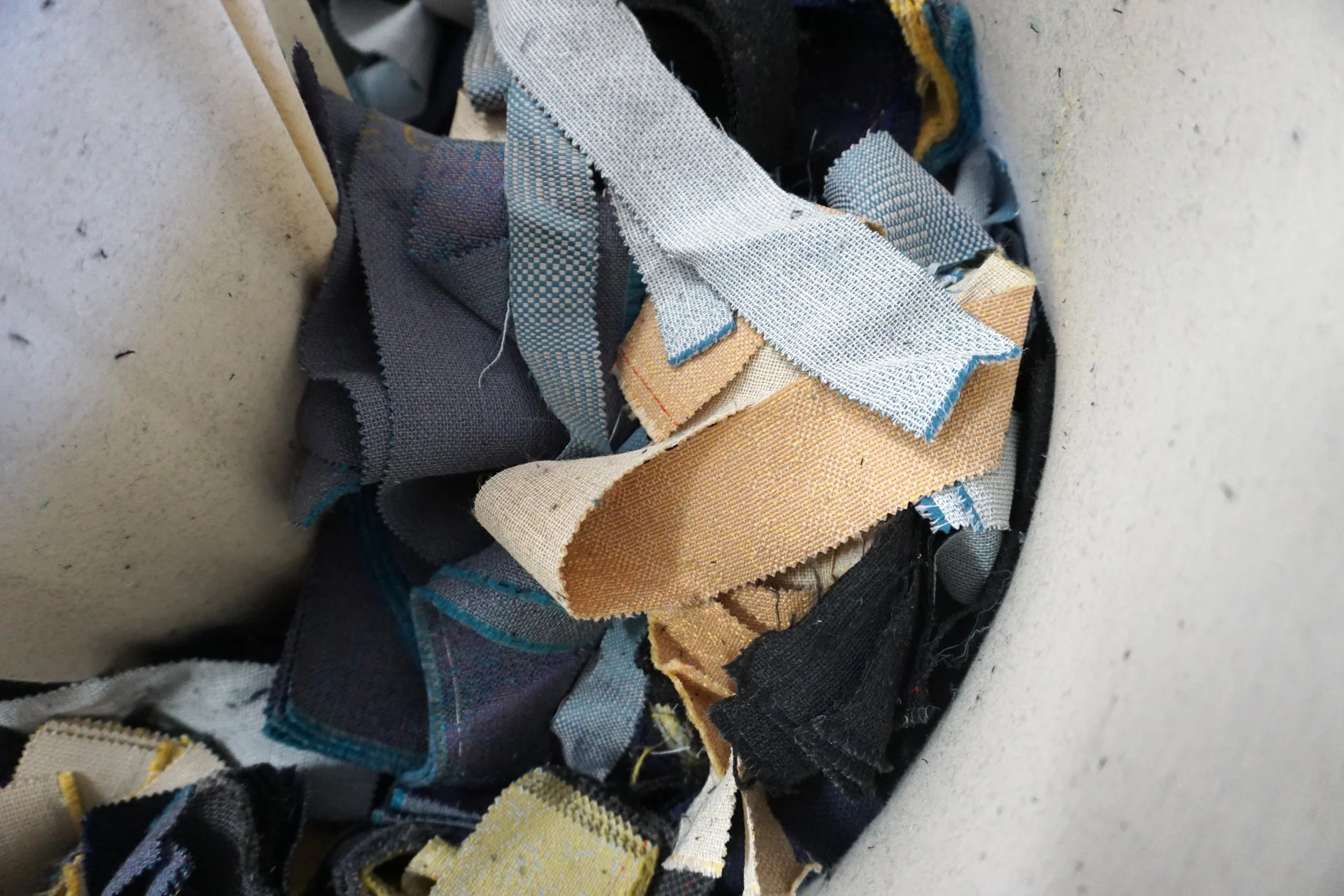
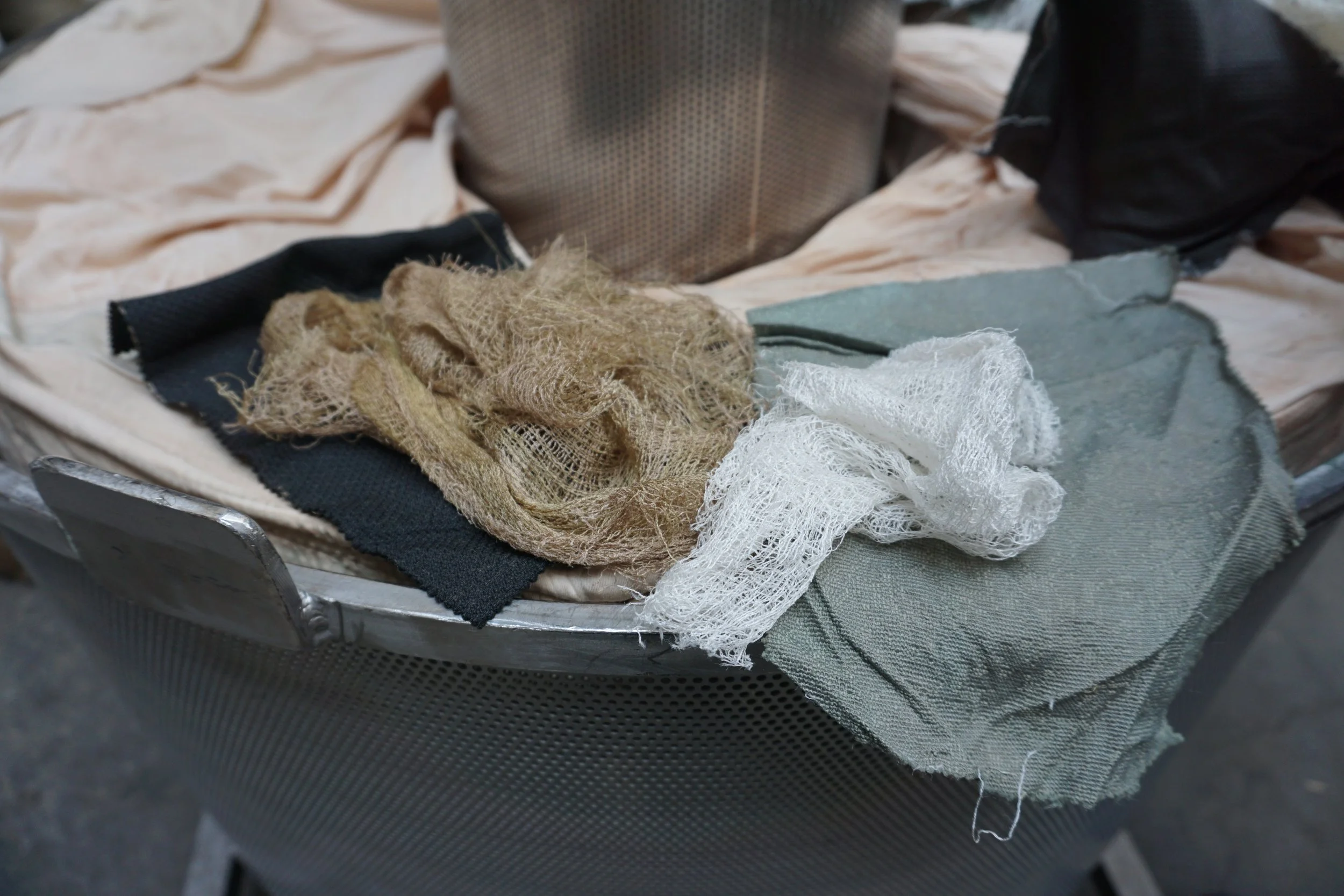
Offcuts from production before and after separation.
Ecologically and economically sustainable.
Offcuts are an often invisible but problematic by-product of textile production. Around a third of new fabrics are lost during the manufacturing process, whether it's trousers, sofas, jackets or office chairs. This is precisely where the Re:Circled project comes in. Using an Interstuhl office chair as an example, offcuts are collected, processed, and then returned to the furniture industry as new materials, forming a circular model. This keeps all resources in the cycle. This closed-loop recycling model is intended to demonstrate that circularity is not only sustainable, but also scalable, and provide viable and economically relevant evidence to prove it. «Incentives are needed to encourage companies to transform their linear production methods into circular ones», says Linda Grieder-Kern, CEO and founder of RethinkResource, who is also an expert in lifecycle management.
“Incentives are needed to encourage companies to transform their linear production methods into circular ones.”
Multi-stage process enables textile circularity.
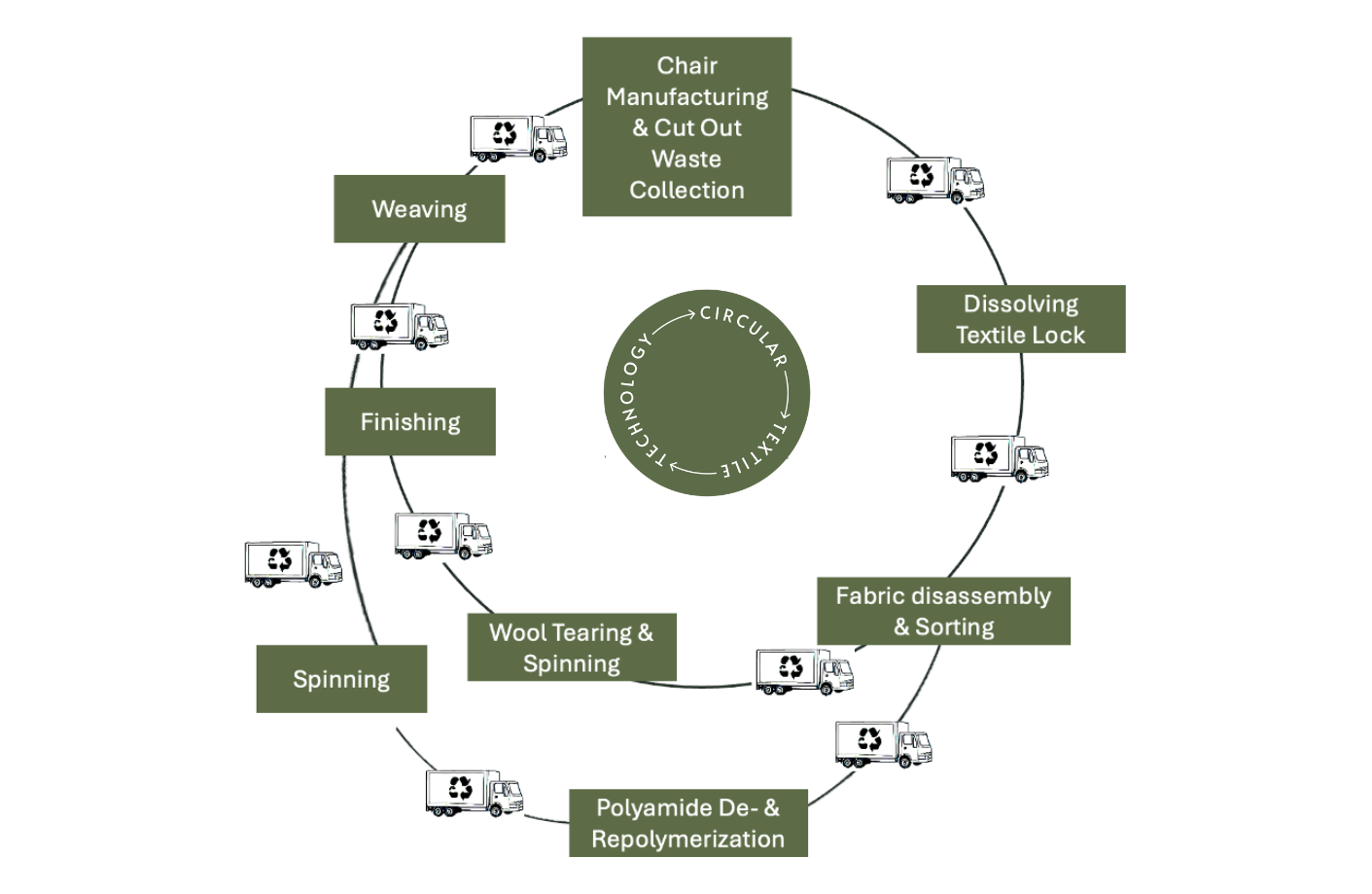
The textile product supply chain is complex, particularly when considered in a circular way. In the Re:Circled project, for example, the chair manufacturer Interstuhl collects offcuts during production, separating the textile remnants by type in subsequent stages. This takes place at the Swiss textile dyeing plant Johann Müller, where the fabrics are broken down into their original materials using high-pressure hot water at 120 degrees. During this process, the 'textile screw' of the CLIMATEX technology is loosened, enabling the separation of wool and polyamide. The wool fibres are broken down and the polyamide undergoes de- and re-polymerisation. The result is pure recycling, enabling the production of new yarns that can be woven back into fabrics.
“CLIMATEX fabrics combine high seating comfort and durability with a circular material architecture that enables resource-conserving and responsible design of modern working and living spaces.”
Closing the loop.
These steps make it clear that no company can manage such a showcase alone. In addition to the aforementioned partners, other reliable partners are required throughout the value chain. These include the leading polyamide 6 manufacturer, Aquafil, and the wool specialist, VLNA, who are both experts in their respective fields. Re:Circled aims to make this project the starting point for a larger network, with an increasing number of partners participating in this circular chain. The more material that is collected and recycled, the more economical the model becomes.
«Once the processes are in place, it becomes easier for others to join in, too», says project manager Franziska Ostermeier. «Each proof of concept and each hurdle we overcome brings us closer to achieving our vision of a functioning, economical material cycle.»
“Each proof of concept and each hurdle we overcome brings us closer to achieving our vision of a functioning, economical material cycle.”