
«Raising awareness of the benefits of sustainable products remains one of our biggest challenges.»
Working for a good climate - both environmental and interpersonal – is firmly anchored in the mission statement of the Bielefeld-based JAB Anstoetz Group. In this talk, Managing Partner Claus Anstoetz provides exciting insights into the importance of design, acoustics and healthcare, talks about the requirements for a textile cycle – and reveals why he is particularly looking forward to Orgatec this year.
CLIMATEX: JAB Anstoetz has long been committed to sustainability. What are you currently working on? And how do you sensitise your employees to this complex issue?
Claus Anstoetz: Far from being a trend, sustainability has played a central role in our business for more than 20 years. We installed photovoltaic systems back in the 2000s, followed by a combined heat and power plant in 2008. Since then, we have continued to invest in small and large sustainable projects. Our employees receive regular training on sustainability issues and are encouraged to be proactive in bringing sustainability into the business. Since 2021, we have been a member of the UN Global Compact network, committing ourselves to sustainability and setting our own targets. We are constantly improving – even though there is still much to do.
What are you hearing from the market in terms of demand for sustainable products?
Environmental awareness has increased in recent years and many sustainable products have come onto the market. With circularity as the supreme discipline, cradle-to-cradle products are for me the benchmark that needs to be achieved. However, we continue to hear that consumers are not willing to pay higher prices for sustainable products and are opting for conventional products instead. Raising awareness of the benefits of sustainable products remains one of the biggest challenges we face.

«With circularity as the ultimate discipline, Cradle to Cradle Certified products is the benchmark I want to achieve.»
Claus Anstoetz,
Managing Partner
JAB Anstoetz Group
So people are price-sensitive when they want to buy more sustainably?
Price is and will remain a regulatory factor. But we are seeing a change, for example among architects and construction companies, because many simply want – and need – to build more sustainably. Ecologically responsible construction involves using materials that are also sustainable or, at best, recyclable. In interior design, we see the greatest potential for sustainable and/or recyclable textiles in public areas such as offices and healthcare, where high functionality is required.
With 1.5 million seating units installed, CLIMATEX is strongly represented in the office sector, where there is a high demand for performance fabrics. What is your view on healthcare and healing architecture?
Functionality and performance fabrics are also particularly important in this sector. The healthcare sector is growing rapidly, especially in terms of retirement and nursing homes. There is a lot of development to be done in the coming years to meet the increasing demand. Textiles play an important role in creating a sense of well-being, both haptically and visually.
The JAB Anstoetz Group is active in many areas. As «The Design Company», how do you ensure that you live up to your own sustainability standards?
With the claim «The Design Company», which we introduced two years ago, we want to emphasise that many internal and external designers work for us and think about innovation and design on a daily basis. Sustainability is a key criterion in product development - in all areas. It's not just about the product itself, but also about issues such as logistics, packaging and countries of origin. We take a holistic approach to sustainability. That is why we are increasingly focusing on sustainable materials, such as recycled materials and recyclable products that can be returned to the cycle at the end of their life. However, it is important to remember that recycled materials require a high material input.
“Sustainability is a core criterion in product development across all areas. It extends beyond the product itself to include logistics, packaging, and sourcing locations.”
Do you take back materials to send to recycling plants or recycling projects?
This will certainly be the future. There is no real cycle yet. But a lot of work is being done. There are already a few, but very decentralised, places where textiles can be returned. But the aim must be to provide a comprehensive return option. It makes no sense to take something back and then transport it several hundred kilometres to be recycled.


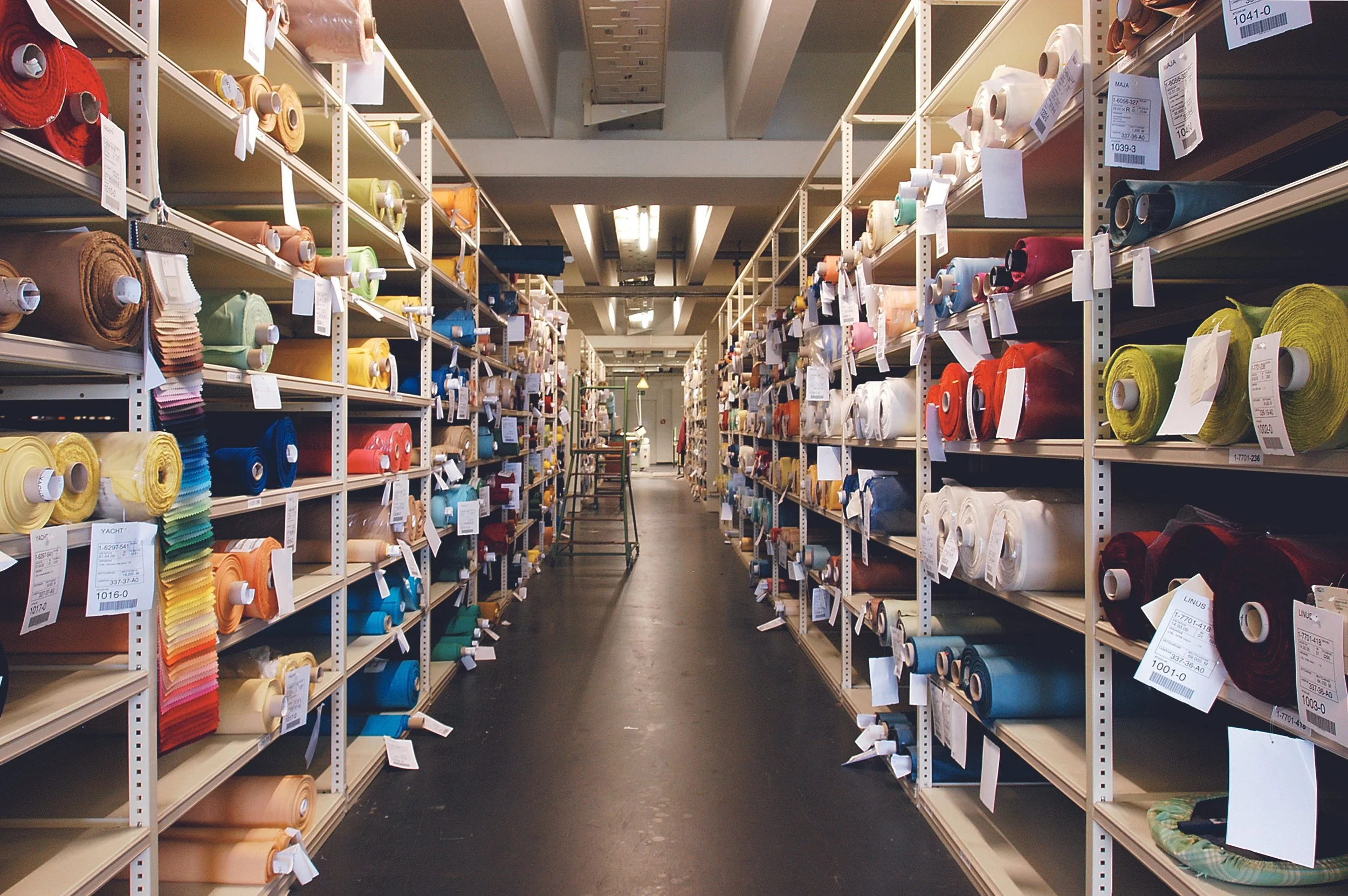
Photovoltaic panels on the roof and the design centre and warehouse inside reflect the creative work of the JAB Anstoetz Group at the Bielefeld site.
Can you imagine the JAB Group running a recycling plant one day?
Never say never. But we are textile entrepreneurs, fabric wholesalers, carpet makers and upholstery manufacturers at heart. I doubt that we would be particularly talented at running a recycling plant. But there may be opportunities in the future to make processes more efficient or even to gain a competitive advantage. This applies not only to our products, but also to the many other recyclable products from various industries. In this way, we are already approaching the EU's planned Green Deal.
What changes do you expect to see at JAB Anstoetz as a result of the Green Deal?
There is a lot of information floating around at the moment. We are taking a wait-and-see approach and developing our products to be sustainable – not just because it sounds good. Of course, we hope that the regulations will be sensible and effective. In Germany there is perhaps a little too much regulation and politicisation, which is a burden on business. But when it comes to sustainability, these regulations are important to make progress.
But it takes time to understand these regulations and coordinate them with our upstream suppliers. Many of our market partners do not have their own production facilities, so we also have to consider implementation in countries such as China, India, Italy and Turkey. The higher costs also have an impact on prices, and we need to ensure that prices do not become too high, otherwise demand for sustainable products will fall.
“Of course, we hope that regulations are sensible and effective. In Germany, there is perhaps a tendency toward overregulation and politicization, which places a burden on businesses. At the same time, these regulations are important for advancing sustainability.”
Wie nehmen Sie die derzeitige Stimmung unter Ihren Lieferanten wahr?
Aufgrund der konjunkturellen Schwierigkeiten ist die Stimmung in ganz Europa angespannt. Energiekrise, Krieg und Inflation, vor allem in der Türkei, bereiten den Lieferanten Sorgen. Darüber hinaus belasten Lieferkettenprobleme und längere Transportzeiten die Kosten und Prozesse. Trotz dieser Herausforderungen bleiben wir positiv und setzen auf Innovation.Die Zusammenarbeit mit CLIMATEX ist für uns besonders spannend, da wir eine enorme Innovationskraft erleben. Genau diese Innovationsfähigkeit sehen wir als Chance, die Branche nachhaltig positiv zu beeinflussen.
Wo sehen Sie das grösste Potenzial für die Zusammenarbeit mit CLIMATEX?
Im Office-Bereich, insbesondere im Bereich New Work. CLIMATEX ist hervorragend geeignet, die Anforderungen an Nachhaltigkeit zu erfüllen. Die Herausforderung besteht darin, unsere technischen Produkte so weiterzuentwickeln, dass sie nicht nur modern und funktional, sondern auch wohnlich und gemütlich wirken. Ziel ist es, Produkte zu schaffen, die sowohl technisch als auch haptisch ansprechend sind.


Inside the modern showrooms of the JAB Anstoetz Group, where innovative textiles and exclusive interior concepts are presented.
What other issues does the JAB Anstoetz Group deal with?
Acoustics is a very important issue for us because the changes in the New Work environment brought about by the increasing role of home offices and the resulting smaller office spaces present new challenges. As spaces get smaller, walls come down, which has a significant impact on acoustic conditions. This is why we have set up our own acoustic laboratory and employed an expert to develop innovative products. Our acoustic modules for ceilings and walls, as well as acoustic curtains and partitions, create small, communicative spaces. These solutions offer great opportunities to improve the acoustics in modern offices.
Will you be exhibiting these products at Orgatec?
Yes, we will be showing our sound-absorbing curtains and the beautiful acoustic panels we have developed in collaboration with the renowned Berlin interior designers, Studio Aisslinger. These panels can be used in a variety of ways on walls and ceilings and can be combined with other products such as carpets and upholstered furniture.
What other highlights can visitors to JAB Anstoetz expect at Orgatech?
In addition to acoustic products and CLIMATEX, we will also be showcasing our textile and hard flooring portfolios. I am looking forward to the show because there will be a lot of well-known companies and we can expect a high level of innovation. I recommend everyone to come to Cologne, especially for the office and contract sectors. It is going to be a very interesting event!