
«Sustainable products must be the best and most attractive option.»
From yarn-to-yarn recycling to the implementation of artificial intelligence – Marte Hentschel, expert and professor for sustainable fashion and Co-CEO of VORN - The Berlin Fashion Hub, drives ecological and circular technologies from the idea to industrial implementation. In our Circular Talk, the Berliner talks about digital innovation and setting the political course for a functioning circular economy in the clothing industry.
CLIMATEX: Marte, you have been an integral part of the sustainable fashion scene for many years and have seen the industry from many different perspectives. What is on your mind right now?
Marte Hentschel: As a professor, I train the next generation of designers in sustainable fashion and design. And as co-director of VORN – The Berlin Fashion Hub for sustainable innovation in the fashion and textile industry, I work with our team to research solutions for the circular transformation of the industry. Since 2022, VORN has served as a platform for developing and testing market-ready technologies – in collaboration with numerous stakeholders from all stages of the textile supply chain. Since March 2025, our new microfactory SHIFT has offered start-ups and researchers the opportunity to work together to bring innovations to industrial maturity. Our small demonstration factory is designed to show how such processes can be scaled up to industrial standards.
What exciting things are there to report from your lab, which opened in March?
Our yarn-to-yarn recycling is a real innovation that overcomes one of the biggest hurdles in the fashion industry – the non-recyclability of mixed fibres. Our process differs from conventional yarn-to-yarn recycling that instead of shredding the textiles, we separate them in a first step to recover the yarn without shredding the textiles. In a second step, these are processed and reknitted. Regardless of the material composition, the yarn can be mechanically unwound and re-knitted several times – without the addition of new fibers. This saves up to eight process steps and avoids material losses. This makes the process particularly resource-efficient and sustainable. However, in order to produce high-quality recyclates, fibre properties, finishing and careful use by the end consumer are of great importance.

"It is not enough just to wait for
political decisions.
We need a strong lobby to push
the issue and ensure
that clear and uniform
regulations are created."
Marte Hentschel
Co-CEO VORN - The Berlin Fashion Hub and Professor
The circular economy is often complex and overwhelming, even for experienced textile professionals. How do you plan to change this?
A major challenge for the circular economy is that around 80 per cent of a product's environmental footprint is determined at the design stage. Designers therefore need the tools to develop circular products. We support them with solutions that help them design durable, high-quality products that can be recycled in an economically viable way. However, as the quality of materials and products has declined significantly in recent years, loss of quality is a major challenge today. Less and less second-hand clothing can actually be resold, making the collection, sorting and recycling of textiles increasingly unprofitable. We need to enable manufacturers to design their products from the start in a way that they can remain in the cycle later on.
So the challenges are of a systemic nature?
Exactly. No organisation can manage this transformation on its own. The transition to a circular economy requires cooperation at all levels. But a lack of clarity in the political regulations is holding companies back. Although they recognise the demand for sustainable products, they are hesitant because it is unclear how regulations such as the Digital Product Passport or the Supply Chain Act will be implemented. This uncertainty is weighing on the fashion industry and delaying much-needed innovation.
“EIt is not enough to wait for political decisions alone. It requires a strong lobby to drive the topic forward and ensure that clear and consistent regulations are established.”
Does politics play a key role in this?
Definitely. Companies need to know what to expect and in what timeframe they can expect specific requirements. What we are seeing at the moment is a lack of clarity – and that is a big risk. A harmonised approach would be beneficial, so the industry needs to raise its voice and push for explicit regulation. It is not enough to just wait for political decisions. A strong lobby is needed to drive the issue forward and ensure that clear and consistent regulations are created. Europe has a huge opportunity to benefit from this transformation; the fashion industry could consolidate economically and take advantage of a more sustainable, transparent supply and value chain. If this potential is properly realised, Europe can play a leading role in the global fashion industry.
What are the challenges of transparent supply chain management?
Supply chains are complex and manufacturers and suppliers are under enormous pressure. At the same time, there is a lack of incentives and support for them to meet all the requirements. Brands should work more closely with manufacturers, take more responsibility in product development and invest in sustainable infrastructure. Tax incentives or reduced VAT could also support sustainable products. Ultimately, however, consumers also need to be encouraged by political policies – we cannot expect the transformation to succeed only through guidelines on the production side alone.


"The transition to a circular economy requires cooperation at all levels," says Marte Hentschel at the opening of the SHIFT microfactory in the Berlin Fashion Hub at the end of March.
What can be done to promote sustainable consumption?
Fast fashion products are currently the cheapest, most accessible and best serviced products on the market. They're easy to buy online, you can try them on at home and return them free of charge if you don't like them. The sustainable alternative lags far behind. A systemic approach must ensure that sustainable products are the best and most attractive option for consumers. This can only be achieved by creating incentives and conditions that clearly highlight the benefits of the green choice.
“A systemic approach must ensure that sustainable products are the best and most attractive option for consumers.”
What is the role that digital technologies and artificial intelligence are playing in this transformation?
Digital technologies and AI offer huge potential for this complex industry: automated processes, simplification of data collection and, in particular, AI-driven recommendations for designers can help designers make conscious and informed decisions and design more sustainable materials and production processes. However, there is also a risk that AI could accelerate the phenomenon of ultra-fast fashion, because if it costs almost nothing to design and bring goods to market, there will be a massive increase in the number of products that are produced in a very short time and then quickly disposed of. That's why clear regulations are needed to ensure that only products that meet certain sustainability criteria are put on the market.
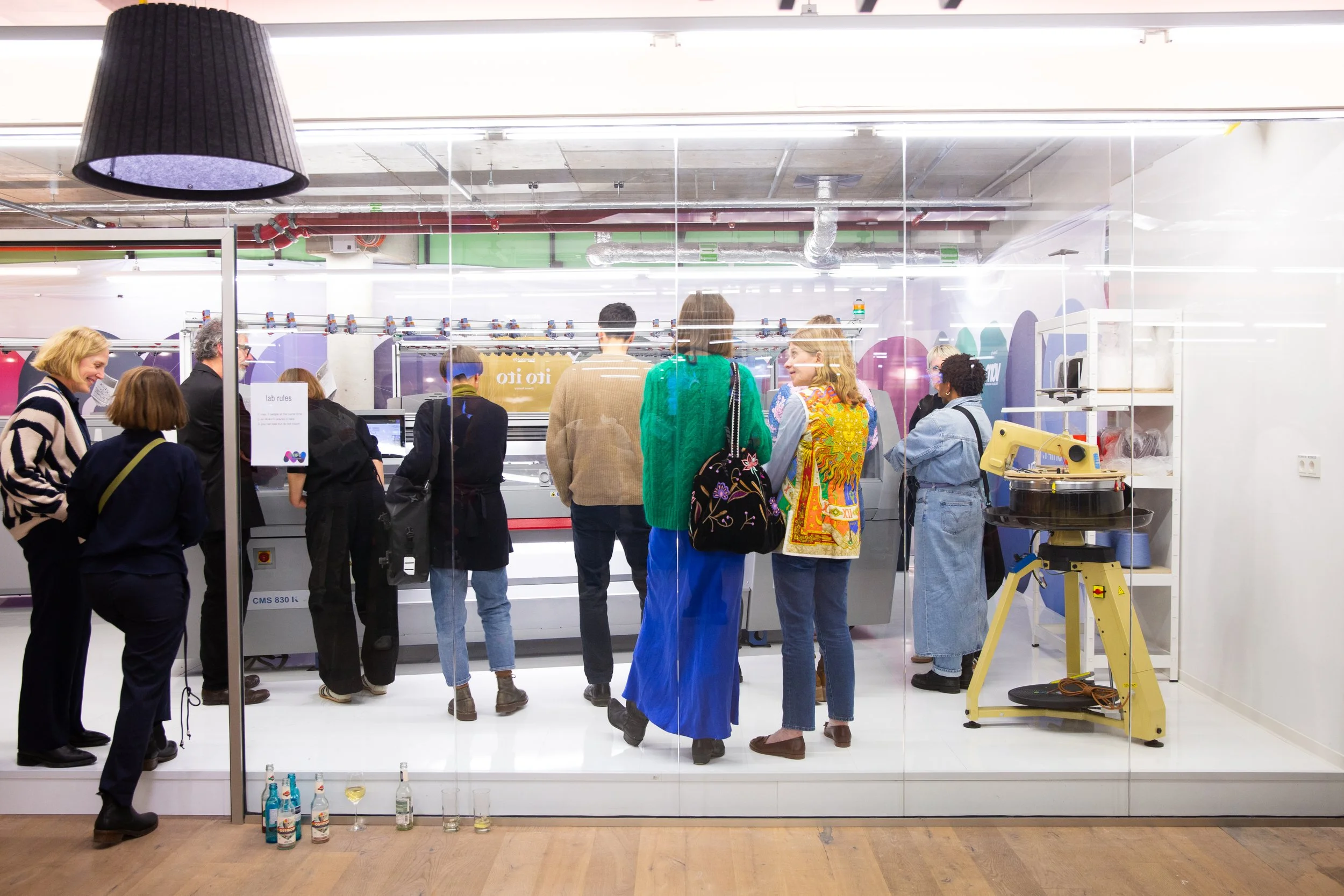

In the SHIFT Microfactory, textile innovations can be developed to industrial readiness.
What is the state of education and knowledge about sustainable design?
They are behind the times and lack the flexibility to react quickly to new demands. As an entrepreneur, I also often had difficulties finding well-trained specialists, which is why I decided to become active in teaching myself as a professor. Young designers need to learn how to initiate sustainable change in different areas of a company.
What can consumers do in support of a more sustainable fashion industry?
Consumers need to be aware of the impact of their purchasing decisions on the environment and working conditions. When they consume ethically and sustainably, it forces the industry to adapt and offer more sustainable solutions. At VORN, we support designers and brands to use sustainable technologies and implement ideas, because small businesses and innovators are driving the industry forward with their drive for innovation. But in order to scale their solutions, the support of large companies like Zalando is crucial. That's why I'm really looking forward to our showcase at Berlin Fashion Week 2026, where we will present sustainable products created in our Design Academy with Zalando.
CLIMATEX has been asked to sponsor materials for the third edition of the Design Academy organised by VORN – The Berlin Fashion Hub and Zalando. As a participating company, young design talents whose aim is to drive the transformation of the fashion industry can use our innovative sewing thread STITCHLOCK for their collections. The focus of this year's Design Academy, which is attended by around 100 designers, is on adaptive fashion to make dressing easier for people with disabilities.